
Showing posts with label Collaboration. Show all posts
Showing posts with label Collaboration. Show all posts
Monday, 9 December 2013

Thursday, 14 November 2013
Environment Church - Model and UV
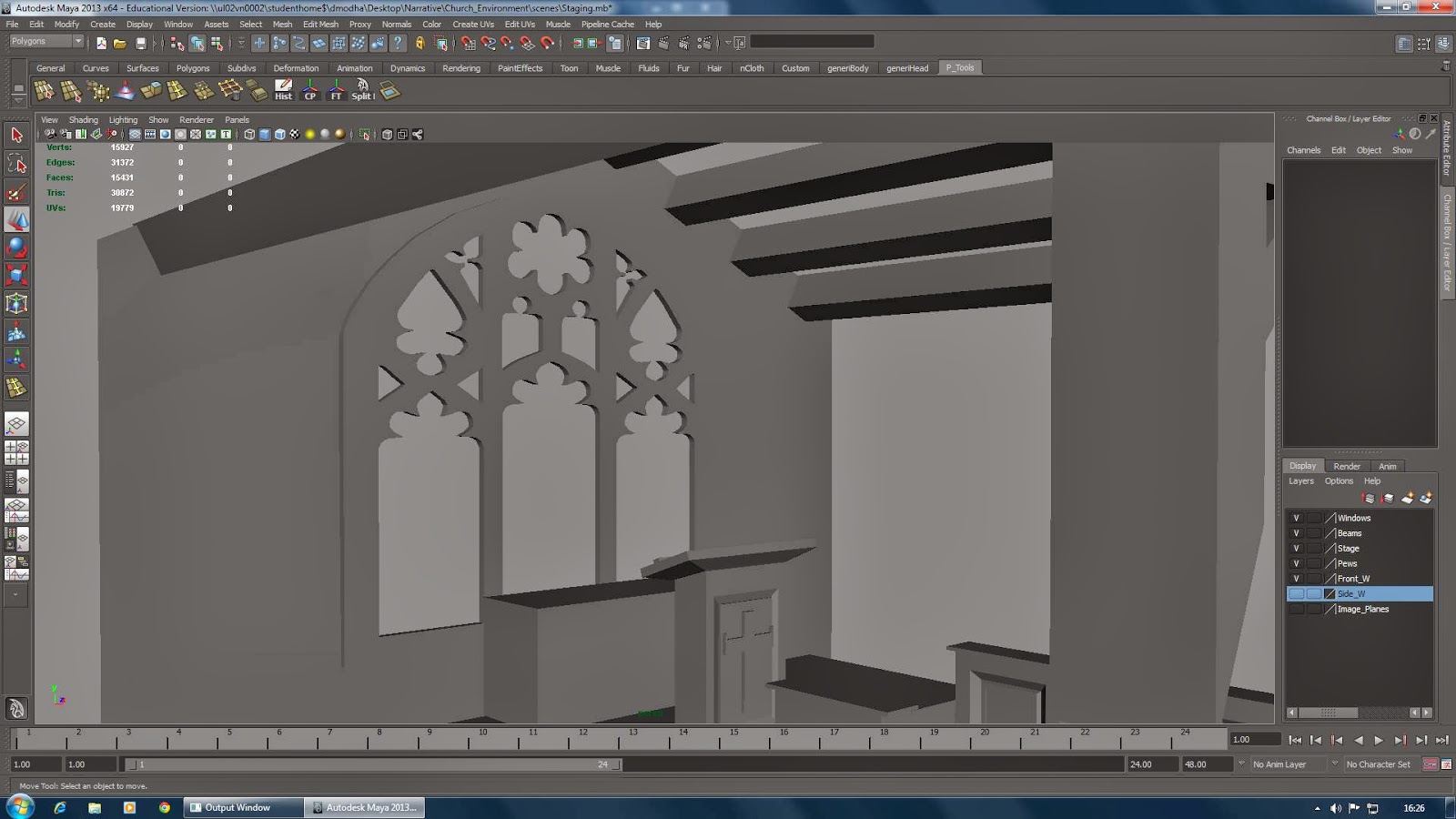
I have finally managed to get the church modelled and UV'd.


Wednesday, 13 November 2013

Monday, 28 October 2013
Environment Re-Visit
The feedback from our pitch made us rethink our choice of environment. We initially went with an outdoor setting in the forest to symbolize the "church" and Religion, being natural and pure. However, we were lead onto a more obvious choice as to set our scene.. In an actual Church.
This made sense for a number of reasons, to show the Religious element there isn't really a better way than to use the house of God, and the eaves of the church can be visually quite amazing, as the view from above looking down on the seats and the altar can be portrayed very well.
Before I start painting concepts, I put together this influence map ti help me visualize the style of a 15th Century style church with the huge stained glass windows and high ceilings.

This made sense for a number of reasons, to show the Religious element there isn't really a better way than to use the house of God, and the eaves of the church can be visually quite amazing, as the view from above looking down on the seats and the altar can be portrayed very well.
Before I start painting concepts, I put together this influence map ti help me visualize the style of a 15th Century style church with the huge stained glass windows and high ceilings.

Wednesday, 16 October 2013
Script - Final Draft
As our first script was generic and only showed the stages, I revised it and went back adding the sound stages as well.
Monday, 14 October 2013

Influence Maps - Mechanics and Birds

Mechanically we want to make the bird look reminiscent of Leonardo Da Vinci's Ornithopter. I looked at different cogs and mechanisms, the smaller versions, like the ones in watches were a good insight into how they would work in small scale, as the bird isn't going to be huge.

When looking at birds, I mostly looked at the wings, and this is the most prominent part of the creature, it is the part they display in terms of mating and intimidation. The poses are very graceful and generally have a menacing nature.
Sunday, 13 October 2013
Influential Videos
PERCEPTON OF CONSEQUENCE
When finalising our idea based on the transformation of a mechanical bird in a natural environment, we started to look at videos which might help us visualise different scenes for our final animation. This video involves long takes, and slow paced camera movements which creates a dramatic effect. We all thought these aspects could be a nice touch, as our intention is for the audience to be moved by our short animation.
SHAPESHIFTER
We all liked the idea about how mechanics vs nature was represented in this animation, and also the use of the low angles and the swaying camera movements when the mechanical animals were running through the forest. We also liked the use of sound - the soft music and sound effects, it creates a more touching finalised short.
FLUX
The ambient flow of the music is quite spacial which compliments the flow of the animation itself. We want to achieve a well rounded combination of the two which sets the tone of our story.
Thursday, 10 October 2013
Research - Da Vinci's Inventions
Da Vinci based his flying machine on the structure of kites, and the wings of birds and bats. It is more evident that his used a bats wing, as it has a very similar bone structure (Fig. 1)

Fig. 1

Fig. 2
It is also evident that Da Vinci used kites as a inspiration, he used the idea of sporadic movement but with stability is the basis of his design, to be able to maneuver quickly but effortlessly.
Da Vinci replicated the way the bat's wing is formed by using a light wood structure, most likely pine and covered it in raw silk. It was intended as a one man machine, that used all of the body parts of the pilot, merging the two together. The pilot pedaled with his feet, like a bicycle while using his arms as stabilizers. To steer, the pilot simply looked in the direction they wanted to go, the movement of the head triggered a collection of pulleys that turned the wing bar in a certain direction.
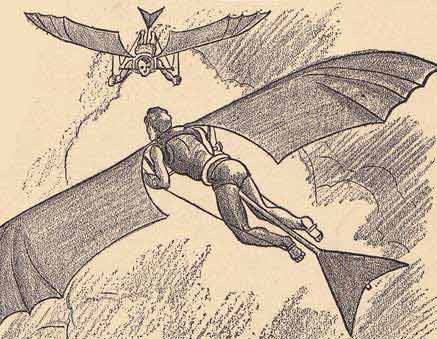
Fig. 3
Da Vinci was obsessed with pulleys and cogs, all of his inventions used them. He found them the easiest way to convert and transfer energy to separate mechanisms.

Friday, 4 October 2013
Final Plot Idea
After much consideration and much discussion, we have finally come up with an idea that encapsulates the idea of the birth and rise of science during the Renaissance Period.
The scene starts in a nest in a tree and we see an egg ready to hatch. the egg hatches and a baby bird emerges but is wooden and mechanical, reminiscent of Leonardo Da Vinci's inventions. The bird then progresses in size and more mechanical parts grow and form onto the bird and then it runs along a branch and flies off, as it flies off the camera follows it upwards towards then sun, where the camera fixates and zooms in, the sun being the final lamp.
Failed Plot Ideas
Renaissance Story Ideas
Basic Plot:
Plot 01:
Leonardo Da
Vinci sets out to “build” the Vitruvian man, based on his painting and workings
out by Vitruvis (c. 100 BC). He follows a checklist acquiring different body
parts from different people, in a fit of rage. The rage is triggered by two
things, he has a breakdown while drawing the Vitruvian man and takes his
glasses off, and his eyes go “hazy”. The same emotion is then mirrored in the
music which goes from calm to silence with a distinct heartbeat throughout. We
then see him with an axe covered in blood with a few body parts on a table with
the checklist next to them, with “items” ticked off, he also has his glasses
back on. He then goes back to re-working on the Vitruvian man painting where he
once again loses his mind and goes on another killing spree, this time we see
all of the body parts on the table, checklist complete. There is a cut to a
silhouette of the Vitruvian man, made in a Frankenstein-like way, when
policemen come in to arrest him. His glasses fall off as we pan up to see the
finished figure, as a shine of light emanates from behind, fading out to white.
Plot 02:
A darkened
figure is hurrying around a workshop drawing and fixing together a sculpture;
we see montages of papers being strewn across the room, tools, a pedestal,
chains, and body parts. We are then shown some images of unwanted parts thrown
onto a pile. People’s faces are shown in horror, implied murders, axe shown, no
actual death is filmed. We then see him finishing the sculpture, but it is
shielded from view, he is then arrested and dragged out of the workshop as the
camera pans to the Vitruvian man, revealing the fact that the man is Leonardo
Da Vinci. However we see the shadow of another person in view, as light emits
from behind the Vitruvian Man
Plot 03:
When people
used to drink whisky, they would use lead cups. The effect of the lead would
sometimes knock the person out for days, and if found, doctors could not tell
whether they were passed out, or dead so they would rest the body on the family
table and hold a “wake” hoping the person would come around.
A man drinks
so much he gets put into this state, and when his family put him on the table
hoping he wakes, we see inside his mind as a drug trip is taking place until he
finally wakes.
The ancients regarded lead as the father of all
metals, but the deity they associated with the substance was Saturn, the
ghoulish titan who devoured his own young. The very word "saturnine,"
in its most specific meaning, applies to an individual whose temperament has
become uniformly gloomy, cynical, and taciturn as the results of lead
intoxication.
Plot 04:
A Scientist
is trying to figure out a cure for the smallpox disease in his workshop. He
goes to the church to get permission to cut up bodies to find out how the virus
kills, but he is denied access to them. As he leaves he is infected by someone
with the disease, but is unaware. He then goes back to his workshop and starts
to scratch and realizes he is infected, the will to live urges him to hurry up
and find a cure, he works and works and manages to find the cure, but dies in
his workshop before he can show his cure to the world. To stop the disease
spreading, he is cremated and the final lamp is the flame from his body.
Plot 05:
Pedro awakes from his bed and is seen walking from his bed to the door. He attempts to put his hand on the knob however his hand falls straight through, he does it again but this time he falls straight through the door. He goes back to his room and realises his body is still laying bed, and makes him and the audience realise that he is having an out of body experience.
Pedro is seen slouching on a chair fed up. He is facing his coffin where his body lays. He notices the maid sneak in through the door and lift the top of the coffin upwards. He watches her while she sobs, and kisses his lips. The camera now focuses on his physical body in the coffin, when the maid finishes kissing him the maid looks down and notices he has an erection.
Tuesday, 1 October 2013
Friday, 27 September 2013
Initial Research

For our collaboration projects we have been put into groups, our group is
George Nwosisi - http://georgenwosisi.blogspot.co.uk/
Nadia Yadallee - http://nadiayadallee.blogspot.co.uk/
Magdalena
and Myself, we are called WhiteSandStudio
We have been allocated the Renaissance Period, specifically the 15th Century. Through conversing with the group we have decided on focusing on the latter part of the century and have begun to do research on Leonardo Da Vinci and The Vitruvian Man.
This half hour documentary was a really good insight on how Da Vinci went around producing The Vitruvian Man and how accurate it actually is.
Da Vinci based, almost his entire work on The Vitruvian Man on Vitruvius' work on architecture, where he stated that to create true beauty within buildings, you have to have perfect symmetry. Da Vinci then expanded on this by trying to prove that humans have perfect symmetry, and are therefore perfect forms.
One question that has been asked over and over again is a huge philosophical query, which is, if humans are perfect forms, is it mere coincidence, or is it made to fit the nature of numbers.
The original book by Marcus Vitruvius Polo is below, The Ten Books on Architecture.
Subscribe to:
Posts (Atom)